
Behind the Kink: The Psychology of BDSM
What's actually happening in the brain, why so many people are drawn to it, and how to start exploring safely.
It's not what you think it is
BDSM stands for Bondage and Discipline, Dominance and Submission, Sadism and Masochism. It covers a wide range of practices, from light restraint and power play to more intense sensation and pain. What it consistently involves is negotiation, communication, and a high degree of trust between everyone involved.
Research on BDSM practitioners paints a different picture from the cultural stereotype. Studies from the Netherlands and Australia found that people who practice BDSM report higher levels of wellbeing, lower levels of neuroticism, and greater relationship satisfaction than non-practitioners on average. The idea that BDSM is a symptom of psychological damage doesn't hold up to the data.
What it actually is: a structured way for people to explore desire, vulnerability, sensation, and control in a context they've explicitly chosen and agreed to.

Playtime BDSM Bondage Set
Curious about BDSM but not sure where to start? This beginner-friendly set includes restraints and accessories designed for couples who want to explore power play, teasing and bondage together.
A playful way to move from reading about BDSM to actually experiencing it, without needing a drawer full of equipment.
Shop Playtime BDSM SetWhat happens in the brain during BDSM
The short version: a lot.
Physical sensation, including pain at certain intensities, triggers the release of endorphins. These are the same chemicals released during intense exercise. At higher intensities, the brain also releases adrenaline and, in some cases, endocannabinoids, the same receptors targeted by cannabis. The combination creates what practitioners call "subspace," a deeply relaxed, almost dissociative state that can feel euphoric.
Power dynamics trigger a different set of responses. Giving up control in a safe context activates the same parasympathetic response as meditation: cortisol drops, breathing slows, the nervous system shifts into a recovery state. For a lot of people with high-pressure lives, deliberate surrender is one of the few moments the brain actually stops scanning for threats.
On the dominant side, taking on responsibility for a partner's experience activates focused attention and a sense of purpose. Research on dominant partners shows elevated oxytocin, the bonding hormone, during and after scenes. Both sides of the dynamic are physiologically rewarding, just in different ways.
Why giving up control feels good
Submission involves a paradox that takes a moment to understand. You are making an active, informed choice to hand control to someone you trust. The moment you hand it over, the mental weight of decision-making disappears. For a lot of people, that's the entire appeal.
Studies on people in submissive roles show a measurable drop in executive function during scenes. The part of the brain responsible for planning and self-monitoring quiets down. What's left is pure present-tense experience, physical sensation, emotional connection, and the specific kind of focus that comes from being the center of someone's complete attention.
Dominance works differently but is equally cognitively engaging. A good dominant is constantly reading their partner's body language, adjusting intensity, holding the emotional container of the scene. It's a form of attunement, not control for its own sake.
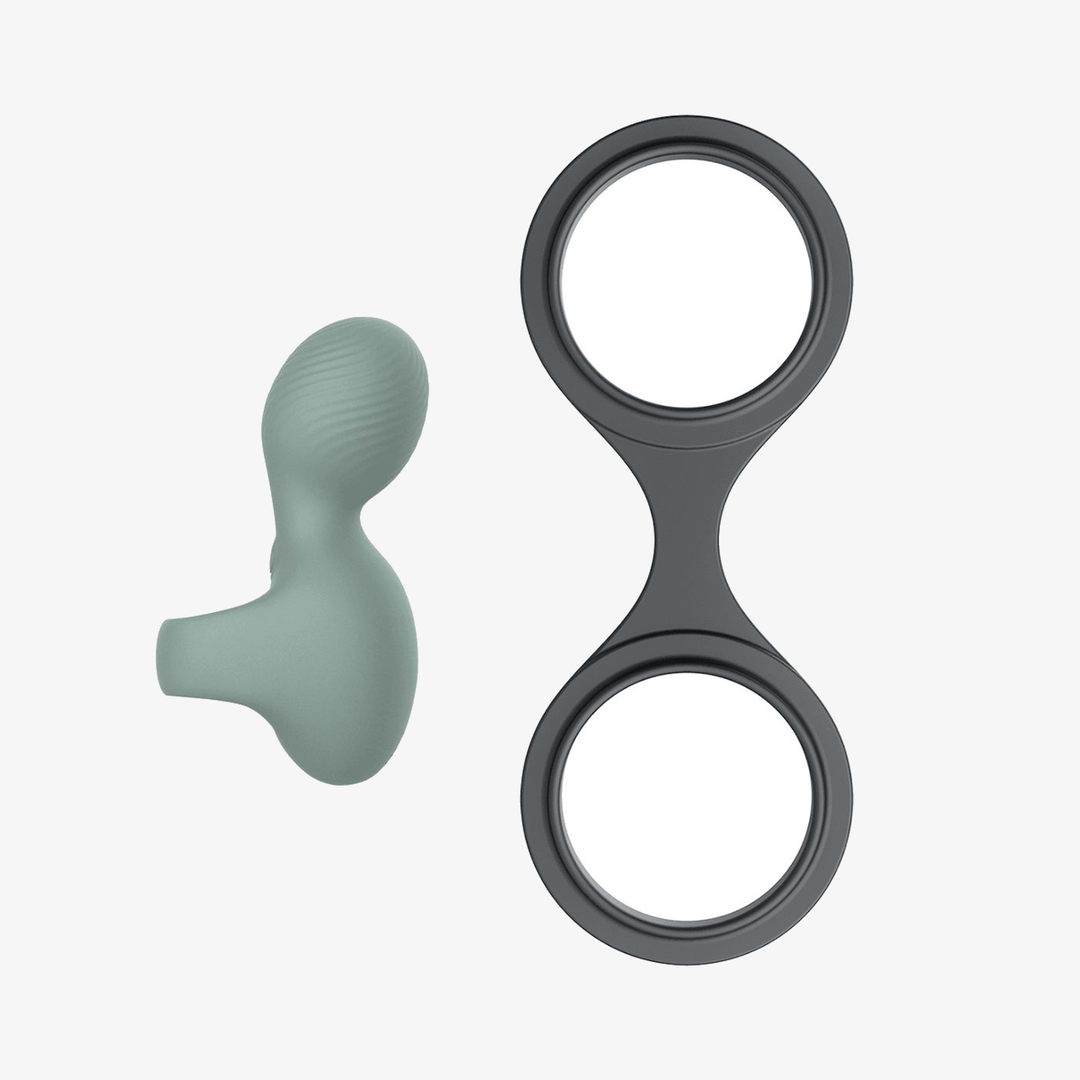
Bound to Please. Handcuffs and a finger vibrator, together.
The Bound to Please set by Peech includes soft restraint cuffs and a finger vibrator. The combination covers both sides of power exchange: one partner restrained, the other with full access. Body-safe materials, adjustable fit. A low-threshold entry point into restraint that doesn't require anything complicated.
Shop Bound to PleasePain, pleasure, and why the line between them is blurry
The brain processes pain and pleasure through overlapping neural pathways. At moderate intensities, pain activates the same reward circuits as pleasure. Anticipation of a sensation, whether pleasurable or painful, produces dopamine. The nervous system doesn't distinguish between the two as cleanly as we assume.
Sensory play exploits this. Temperature, pressure, texture, and vibration all stimulate different nerve endings and produce different combinations of neurotransmitters. People who explore sensation play often describe a progressive heightening where the body becomes acutely sensitive. Every touch registers more strongly. The nervous system, already flooded with endorphins, processes input differently.
This is why many practitioners combine multiple types of stimulation. A light impact followed by soft touch feels more intense than either would alone. The contrast activates more receptors.

AIA Stimulating Gel. Everything feels more.
AIA's stimulating gel increases blood flow to the clitoris and surrounding tissue, making the area more sensitive before and during play. Applied before a scene, it amplifies whatever comes next: touch, vibration, temperature. If you're exploring sensation play for the first time, this is a practical starting point.
Shop AIA GelWhy wax play works
Temperature activates thermoreceptors, the nerve endings responsible for detecting heat and cold. These sit close to pain receptors in the nervous system, which is why warm wax on skin reads as intensely stimulating rather than simply hot. The sensation occupies the brain's attention completely. Everything else falls away.
Wax play is also deeply visual. Watching the wax land, seeing it cool and set, the marks it leaves on skin: all of it is part of the experience. For the person holding the candle, there's the precision of controlling exactly where it falls. For the person receiving, the anticipation of not knowing exactly where the next drop will land produces the dopamine spike that precedes impact.
Massage candles are specifically formulated with a lower melting point than regular candles, meaning the wax cools faster and doesn't burn at the temperature standard paraffin would. The distance you hold the candle from the skin determines the temperature on contact: higher up means cooler, closer means hotter.

Date Night Mood Setter. Massage candle and functional chocolate.
The Date Night Mood Setter pairs a massage candle with The Oh Collective's Date Night Chocolate. The candle melts into warm massage oil and doubles for wax play at controlled temperatures. The chocolate contains adaptogens formulated to increase blood flow and heighten sensitivity.
Shop the Mood SetterWhy forbidden feels so good
Psychologists have a name for the effect where prohibited things become more desirable simply because they're prohibited: reactance. The brain interprets restrictions as threats to autonomy, which triggers increased interest in the restricted thing. This is part of why taboo fantasy is so widespread even among people who would never act on it in real life.
Anal play sits squarely in this category for many people. It's an area the body treats as sensitive and off-limits by default, which means deliberately including it activates the psychological reward that comes from crossing a line in a controlled context. The nerve density in the anal region is also genuinely high, particularly around the pudendal nerve, which connects to the same network as clitoral and penile sensation.
For people with a prostate, anal stimulation produces a specific type of orgasm that involves the pelvic floor differently from standard penile stimulation. For people without one, the indirect stimulation of the A-spot through the shared wall between the rectum and vagina is achievable through anal toys, particularly when used alongside other stimulation.
The key physiological requirement for comfortable anal play is pelvic floor relaxation. The external sphincter relaxes voluntarily. The internal one does not. Sustained, gentle pressure over time signals to the internal sphincter that the contact is safe, and it releases. Rushing this process is what makes anal play uncomfortable. Patience, lubrication, and a tapered shape are all that's needed.

Boo. Remote-controlled butt plug with 10 vibration patterns.
Boo's tapered shape is designed around the physiology of comfortable anal entry. Soft body-safe silicone, ergonomic flared base, 5 intensities and 10 vibrations. The remote control means your partner holds the controls, which adds the power dynamic layer on top of the physical sensation.
Shop BooConsent, negotiation, and aftercare
Experienced BDSM practitioners tend to communicate more clearly about sex than people who don't practice BDSM. The negotiation that happens before a scene requires explicitly naming desires, limits, and signals for stopping. Most use a safeword system: a word or signal that stops the scene immediately, no questions asked.
This upfront negotiation is one of the reasons BDSM practitioners report higher sexual satisfaction. When you've talked explicitly about what you want before it happens, there's less ambiguity during, and less potential for misread signals.
Aftercare is the practice of returning to baseline together after a scene. This can look like physical closeness, warmth, food, quiet conversation, or simply lying together. The physiological reason it matters: the endorphin and adrenaline drop after an intense experience can leave both partners feeling emotionally vulnerable. Aftercare addresses that vulnerability directly rather than leaving people to manage it alone.
How long aftercare takes varies. Some people need 20 minutes. Some need an hour. The practice is to check in, stay present, and not leave someone alone immediately after intensity. That applies to both dominant and submissive partners.
Where to begin
Most people who explore BDSM start much smaller than they think they will. A scarf used as a blindfold. Light restraint with a partner's hands. Temperature play with an ice cube or warm massage oil. The psychological effect of even minimal power exchange is real, and starting gently lets you get a read on what you actually respond to before adding intensity.
The most useful things to establish before anything else: a safeword, an honest conversation about what you're curious about versus what's off the table, and an agreement that either person can stop the scene at any point without explanation. Aftercare isn't optional. Decide what it looks like before you need it, so you're not figuring it out when you're both in a post-scene state.
The BDSM community has a phrase: "your kink is not my kink, and that's okay." The range of what people find interesting is wide. You don't have to want the same things as anyone else, or want what you assume you should want. Exploration is the point.
1 comment
Interested in learning more about dynamics the real and meaning